Snap a photo. Graded in seconds.
Point your camera at a finished worksheet. The grader reads every problem, checks the answer, and marks it — showing the correct answer and a one-line explanation on anything wrong.
How it works, step by step.
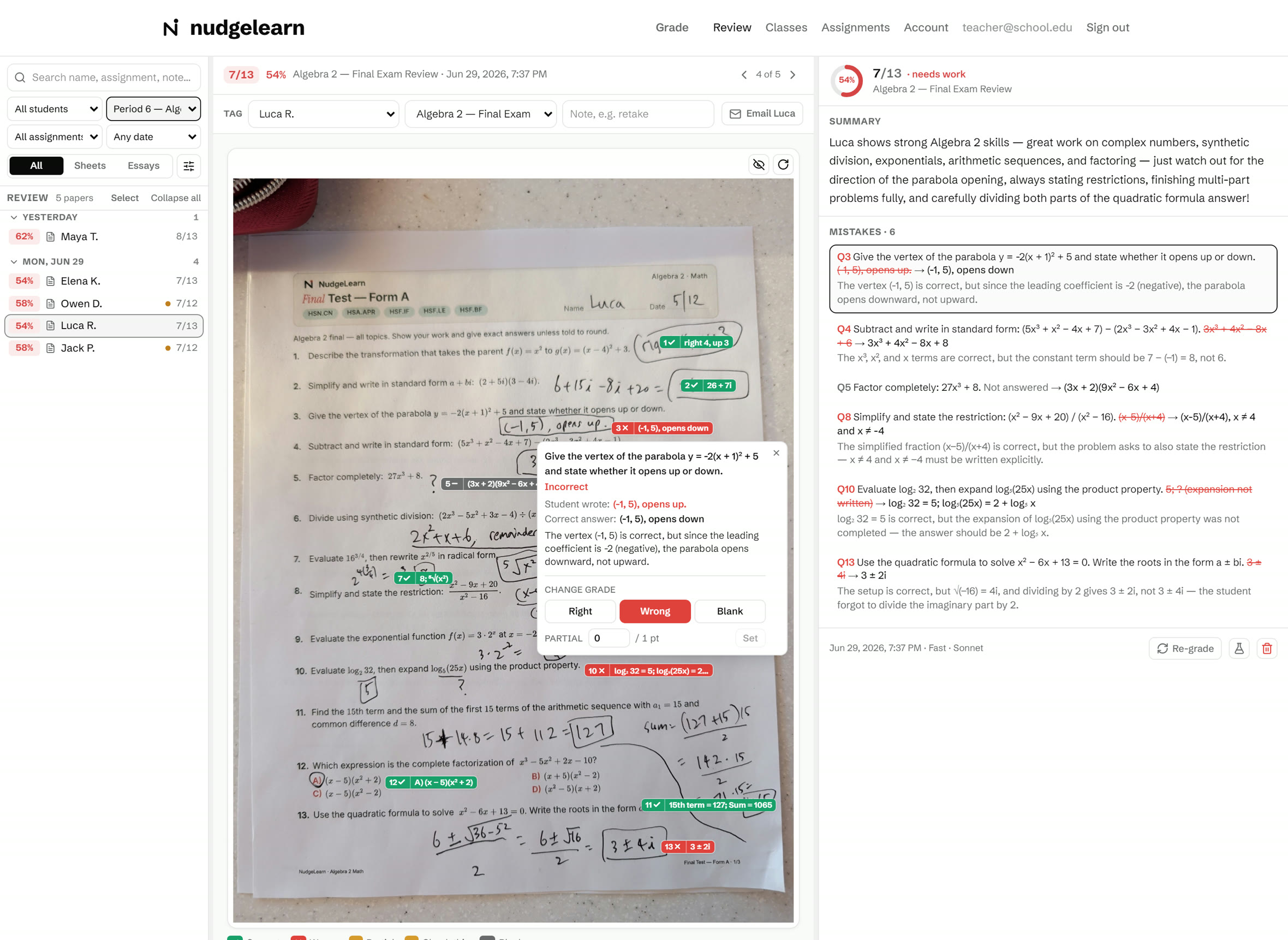
A photo goes in; every problem comes back marked, with the correct answer and a note on each mistake. Step through it below.


Great effort from Luca — most problems are correct, with a few to review: the vertex direction, a constant term, the log expansion, and the last step of the quadratic formula.
The discriminant is √(−16) = 4i, so the roots are (6 ± 4i) ÷ 2 = 3 ± 2i — the imaginary part still has to be divided by 2.
The whole flow end to end — snap, read, mark, and a score with every mistake explained.
What it grades
We grade what has a clear right answer — and flag anything we are unsure about for you to confirm.
New subject? Test before you grade the stack.
Run 3–5 sample papers first and check the marks. The grader flags whatever it is unsure about, so you will see exactly where to look. Once you trust it on a subject, grade the whole stack.
Answers for families and schools.
How accurate is it?
What if it marks something wrong?
Which subjects can it grade?
Do I need an answer key?
What kind of photo works?
Is my child’s work private?
What does it cost?
Can I grade a whole class at once?
Do I get per-student analytics?
Does it fit our LMS and rostering?
How is student data handled?
Is it aligned to standards?
What about volume and unlimited grading?
How do we pilot it?
Rosters, analytics, LMS, and district rollout — let’s scope a pilot.